


How Deep is Your Self Love?
by Jim Malloy
Other Lectures in the Series
Enlightenment for the Rest of Us
Staying Connected
How to Get a Break from All Those Thoughts in Meditation
What in the World is Going On?! How the Consciousness Shift May Be Affecting You
Will & Grace
Having a Hard Time Meditating Daily? Listen to Your Evolutionary Angel
Higher Guidance - It's Closer Than You May Think
Meditation & Calming Emotional Storms
A Daily Dip in the Light
Your Cosmic Journey: The Earth Experience

One of the biggest lessons on the spiritual journey is learning to love unconditionally. However, what is often overlooked, is the importance of loving yourself along with everything else. After all, aren't you a part of the whole of Life? Here is a wonderful old haiku which illustrates this... "On my horse, clip-clopping through the field. Aha! I'm part of the picture!" As you grow to realize that you are an integral part of Life's grand picture, it becomes clear that loving yourself along with everything else is part of the mission.
Some of you may feel uncomfortable with the idea of self love, because it's often interpreted as being overly self involved. Many religions teach that total selflessness is the ideal, and that self love is the antithesis of being selfless. I'm not at all knocking selflessness, but is self love really opposed to selflessness? And is it the same as being too self involved? What actually is self love?
Self love is largely a matter of unconditional self acceptance, with a bit of appreciation and compassion for oneself thrown in. Can you accept yourself unconditionally... that is, without having to fulfill certain conditions, or live up to some particular standard? If not, what do you have to do or be, to fully accept yourself? Do you have to be successful? Do you have to look a certain way? Do you have to be giving all the time? Do you have to be constantly productive? The list of conditions we may attach to self acceptance goes on and on.
If you take a deep and honest look inside yourself, you may find that your conditions for loving yourself are very similar to the (spoken or unspoken) conditions that your parents attached to their love and approval. The idea here, is not to put the blame on your parents. Like most humans, they were probably doing the best they could within their limited framework. And, believe it or not, you chose them as a necessary part of your spiritual curriculum.
However, the common tendency is to adopt these parental conditions as our own conditions for loving ourselves. As we take on these conditions, another interesting dynamic often occurs. We tend to project these conditions for being loved onto Spirit. Somewhere deep in our consciousness, the belief develops that "God will only love me if I'm _______________." (Fill in the blank with whatever conditions you discover.) Of course this belief is absolutely erroneous because Spirit's love is absolutely unconditional.
But in our minds - generally our subconscious minds - our parents' conditions for loving us, Spirit's conditions for loving us, and our own conditions for loving ourselves, all become intertwined. As a result, we may go through life constantly striving to meet these conditions as an unconscious attempt to earn the love of Spirit, family, and self. And because the conditions are rarely attained in full, healthy self love remains elusive.
 What
are the major effects of not loving ourselves?
What
are the major effects of not loving ourselves?
• It makes it difficult to truly love others. This is because we
tend to judge them by the same conditions with which we judge
ourselves.
• It makes it difficult for us to accept love from another, because if we don't fit our conditions for self love, we tend to feel that we are not lovable.
• A shortage of self love also tends to pose a major obstacle to creating the life we hope for. If we believe we are not acceptable to Spirit, we naturally assume that we don't deserve Life's abundant gifts and the loving support of the Universe in our undertakings. This deep belief unconsciously sends a negative message to the Universe - a command to the cosmic computer - which is essentially saying, "I'm not worthy, so no matter how much I might ask, or pray, or whine, do not fulfill my hopes and dreams." In this way, we punish ourselves by sabotaging our own efforts. Spirit never punishes us, but we can do a remarkably good job of punishing ourselves.
On the other hand, what are the positive effects of loving yourself? If you have a healthy sense of self love, you will find it much easier to love others, and much easier to accept the love of others. When you love yourself, you feel deserving of the good things in life and the powerful support of the Universe. This naturally opens the door for your hopes and dreams to be fulfilled more easily, and for your life to proceed with more green lights than red.
Here are some exercises you can do for developing greater self love.
1. Deepening your awareness. That means doing a bit of honest soul-searching... asking yourself, "Is there a shortage of self love in my life? And if so, why?... what are the underlying dynamics?" There are a number of ways to shine a light into the unconscious caverns of your mind... quiet reflection, talking it out with a trusted friend or therapist, or writing in a journal are all good approaches. What works best for you?
2. Convincing your conscious and subconscious mind that the Universal Spirit is unconditionally loving. A willingness to re-examine and toss out old beliefs, and to accept this new belief, is usually sufficient for your conscious mind. However, your subconscious mind - which stores information much like a computer - may need a bit of "re-programming." The daily repetition of a positive affirmation - such as "Spirit is unconditionally loving" - is one of the most commonly used methods for this. Affirmations can be written, spoken aloud, or repeated mentally. Self hypnosis is also a widely used method for re-programming the subconscious mind.
3. Making a list of all your positive qualities. Even though you are cultivating "unconditional" self acceptance, this helps create a shift toward thinking of yourself in a more positive light.
4. Meditating on self love. Here is a simple meditation for learning to accept and appreciate yourself just as you are.
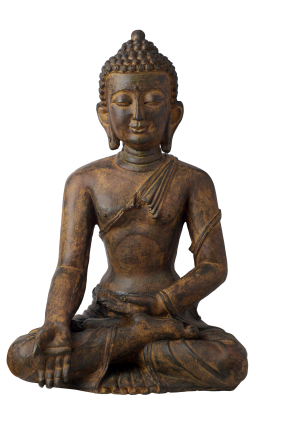 This
meditation is done from the perspective of your "Spiritual
Self." Your Spiritual Self is the quiet, knowing, non-judging
observer within you. All the rest of you... your body, mind,
emotions, personal traits, etc., we will refer to as your
"personality." Just for this exercise, think of your
personality as a separate person.
This
meditation is done from the perspective of your "Spiritual
Self." Your Spiritual Self is the quiet, knowing, non-judging
observer within you. All the rest of you... your body, mind,
emotions, personal traits, etc., we will refer to as your
"personality." Just for this exercise, think of your
personality as a separate person.
• Sit comfortably and close your eyes.
• Now begin to observe your personality... notice your thoughts, your emotions, how your body feels, etc..
• Take some time to get acquainted with your personality. Objectively think about its various characteristics.
• Next, imagine that your personality is your child, and that you are its parent.
• See this child as a perfect creation of Spirit... still growing into its highest potential, but perfect at whatever stage it's now at.
• Accept your child as it is... accept it completely, just as it is.
• Look at your child with appreciation and compassion. Look fondly and compassionately at your child, with all of its strengths and positive traits, as well as it's various weaknesses and follies.
• Open your heart and embrace this child with complete, unconditional love.
Practicing any or all of the above exercises will help deepen your self love. Although encountering challenges along the way is an integral part the spiritual journey, you will find that healthy self love can be a tremendous aid in smoothing out the rough and rocky stretches of your path.
We hope you've enjoyed the lecture. If you would like to receive our weekly mailing - a short meditation quote and tip to encourage meditators to stay on track with their practice - click here. All information you submit will be kept absolutely private.

You can find a variety of meditation mp3s by Jim Malloy in our
Audio Meditation Room
|
Worldwide Online Meditation Center |
 |